Top 3 Gaming Trends Dominating US Market in 2026

Top 3 Gaming Trends Expected to Dominate US Market in 2026, According to Industry Analysts
The gaming industry is a dynamic and ever-evolving landscape, constantly pushed forward by technological innovation and shifting consumer preferences. As we look towards 2026, the United States market stands on the cusp of significant transformations, driven by a confluence of emerging technologies and evolving player expectations. Industry analysts are already pinpointing several key areas that are not just growing, but are set to redefine what gaming means for millions. Understanding these US gaming trends is crucial for developers, publishers, investors, and, of course, the players themselves.
From the depths of virtual worlds to the seamless access of cloud-based platforms and the intelligent design of AI-powered experiences, the future of gaming promises unparalleled immersion, accessibility, and personalization. This article delves into the three most impactful trends that industry experts predict will dominate the US gaming market by 2026, offering a comprehensive look at their current trajectory, potential, and the challenges they might face.
Trend 1: The Exponential Rise of Immersive Virtual and Augmented Reality Gaming
Virtual Reality (VR) and Augmented Reality (AR) have long been hailed as the next frontier in interactive entertainment. While they’ve experienced periods of hype and tempered growth, 2026 is projected to be a pivotal year for their mainstream adoption within the US gaming market. The advancements in hardware, coupled with more compelling content, are finally aligning to deliver on the promise of truly immersive experiences that will be a significant US gaming trend.
Hardware Evolution and Accessibility
One of the primary drivers behind this surge is the continued evolution of VR and AR hardware. Devices are becoming lighter, more comfortable, and crucially, more affordable. Standalone VR headsets, like the Meta Quest series, have significantly lowered the barrier to entry, eliminating the need for expensive high-end PCs. By 2026, we can expect even more sophisticated standalone units with higher resolution displays, wider fields of view, and improved haptic feedback, making the virtual world feel more tangible than ever before. Furthermore, the integration of eye-tracking and advanced hand-tracking technologies will allow for more intuitive and natural interactions, blurring the line between player and avatar.
AR, while perhaps a step behind VR in pure gaming immersion, is also making significant strides. With more powerful mobile chipsets and the potential for lighter, more stylish AR glasses, the ability to overlay digital content onto the real world will open up new genres of gaming. Imagine location-based AR games that seamlessly integrate with your physical environment, transforming your neighborhood into a fantastical battleground or a puzzle-filled adventure. These innovations will broaden the appeal of immersive technologies beyond dedicated gaming enthusiasts, making them a pervasive element of the future US gaming trends.
Content is King: The Growth of AAA VR Titles
Hardware improvements alone are not enough; compelling content is the true catalyst for adoption. In recent years, we’ve seen a growing number of high-quality, ‘AAA’ caliber VR titles that offer deep narratives, intricate gameplay mechanics, and stunning visuals. This trend is expected to accelerate dramatically towards 2026. Major studios are investing heavily in VR development, recognizing its potential to deliver experiences impossible on traditional screens. We anticipate a greater diversity of genres, from expansive open-world RPGs to intricate strategy games and competitive multiplayer experiences, all designed from the ground up for virtual reality.
The social aspect of VR gaming will also mature. Persistent virtual worlds and social hubs will become more sophisticated, allowing players to connect, interact, and game together in shared digital spaces. This social dimension is critical for long-term engagement and will help foster vibrant communities around these immersive platforms. The ability to express oneself through highly customizable avatars and participate in shared virtual events will make VR not just a gaming platform, but a social one, further cementing its place as a leading US gaming trend.
Challenges and Opportunities
Despite the optimistic outlook, challenges remain. Motion sickness, while mitigated by improved hardware and game design, is still a barrier for some. The cost of entry, though decreasing, can still be a hurdle for mass adoption of the most advanced setups. However, the opportunities far outweigh these challenges. The potential for truly novel gameplay mechanics, unparalleled storytelling, and a deeper sense of presence offers a unique value proposition that traditional gaming struggles to match. As developers continue to innovate and hardware becomes more refined, immersive VR and AR gaming are poised to capture a significant share of the US market, fundamentally changing how we experience digital worlds.
Trend 2: The Ubiquity of Cloud Gaming and Subscription Models
The second major force shaping the US gaming trends for 2026 is the widespread adoption of cloud gaming, inextricably linked with the proliferation of subscription-based models. This trend is driven by the desire for accessibility, convenience, and a Netflix-like approach to game consumption, removing traditional hardware barriers and democratizing access to a vast library of titles.
Democratizing Access: Gaming Without Consoles
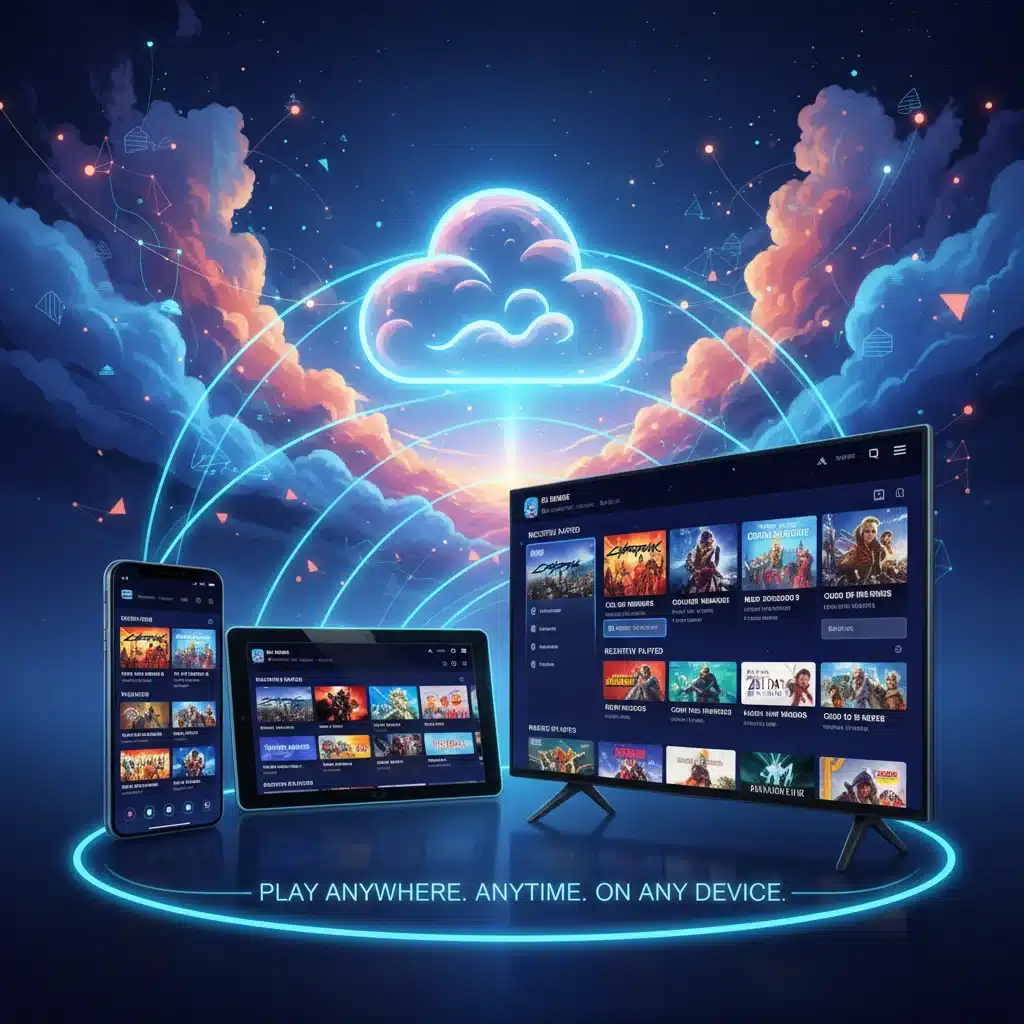
Cloud gaming, also known as game streaming, allows players to access and play high-end video games on virtually any internet-connected device, without the need for powerful local hardware. The game is processed on remote servers, and the video feed is streamed to the player’s screen, while their inputs are sent back to the server. This technology has been steadily improving, with reduced latency, higher resolution streaming, and more stable connections becoming the norm. By 2026, the infrastructure to support widespread, high-quality cloud gaming will be robust across most of the US, thanks to advancements in 5G networks and fiber optic internet.
This means that a player could seamlessly switch from playing a graphically intensive AAA title on their smart TV, to continuing their session on a tablet during their commute, or even on a smartphone during a lunch break, all without owning a dedicated gaming PC or console. This unparalleled flexibility and device agnosticism will appeal to a broad demographic, including casual gamers, those on a budget, and even hardcore enthusiasts who appreciate the convenience. The removal of the upfront hardware investment is a significant game-changer, making high-fidelity gaming accessible to millions more, solidifying its place as a dominant US gaming trend.

The Rise of the Gaming Subscription Economy
Hand-in-hand with cloud gaming is the growth of subscription services. Platforms like Xbox Game Pass, PlayStation Plus, and NVIDIA GeForce NOW have already demonstrated the immense value proposition of offering a vast library of games for a fixed monthly fee. By 2026, these services will be even more refined, offering larger and more diverse catalogs, including day-one releases of major titles, and deeper integration with cloud streaming capabilities.
The appeal of subscription models is multifaceted. For players, it offers incredible value, allowing them to explore a wide range of games without the commitment of individual purchases. For publishers, it provides a stable revenue stream and a mechanism to introduce new games to a broad audience, fostering discovery and engagement. We can expect to see more publishers launch their own subscription services, or integrate deeply with existing ones, creating a competitive yet beneficial ecosystem for consumers. This model aligns perfectly with modern media consumption habits, where streaming services for movies and music are already commonplace, making it a natural evolution for gaming and a defining US gaming trend.
Infrastructure and Market Dynamics
The success of cloud gaming heavily relies on robust internet infrastructure. While the US has made significant strides, disparities in rural broadband access could pose a challenge. However, ongoing investments in 5G and fiber expansion are expected to largely mitigate these issues by 2026. Furthermore, competition among platform providers will drive innovation in streaming technology, pricing models, and exclusive content, ultimately benefiting the consumer.
This shift also has implications for game development. Developers will need to optimize their games for streaming environments, considering factors like input latency and visual compression. The focus might also shift towards games that are well-suited for shorter play sessions across multiple devices. The ubiquity of cloud gaming and subscription models will not only change how we play but also how games are developed, distributed, and monetized, making it an undeniable force in future US gaming trends.
Trend 3: AI-Driven Personalization and Dynamic Game Worlds
Artificial Intelligence (AI) is no longer confined to merely controlling non-player characters (NPCs); it’s rapidly evolving to become a fundamental component of game design, promising unprecedented levels of personalization and dynamic, ever-changing game worlds. By 2026, AI-driven experiences will be a cornerstone of the US gaming trends, offering players games that feel uniquely tailored to them.
Adaptive AI and Personalized Experiences
Current AI in games often follows pre-scripted behaviors. However, next-generation AI will be far more adaptive and responsive. Imagine NPCs that learn from your playstyle, adapting their strategies in real-time, or even remembering past interactions and holding grudges or forming alliances based on your actions. This level of dynamic interaction will make game worlds feel more alive and responsive, creating a deeper sense of immersion and consequence.
Beyond combat and interaction, AI will power personalized content generation. This could range from dynamically adjusting difficulty based on a player’s skill level and frustration tolerance, to generating unique quests, storylines, or even entire environments on the fly. For example, an AI dungeon master could craft bespoke challenges and narratives in a procedural RPG, ensuring that no two playthroughs are exactly alike. This level of personalization will keep players engaged for longer periods, constantly offering fresh experiences and making each game feel truly their own. This move towards highly individualized experiences is a key aspect of emerging US gaming trends.
Procedural Generation and Evolving Narratives
The use of generative AI in game development will extend beyond mere difficulty scaling. It will be instrumental in creating vast, intricate, and continually evolving game worlds. Procedural generation, already a staple in some games, will be enhanced by AI to produce more coherent, meaningful, and aesthetically pleasing content. This means larger worlds with greater environmental diversity, more varied enemy types, and a seemingly endless supply of content to explore.
Furthermore, AI will play a crucial role in shaping dynamic narratives. Instead of following a single, linear story, players might influence an AI-driven narrative engine that adapts the plot, character arcs, and world events based on their choices and actions. This could lead to genuinely branching storylines where the player’s impact feels profound and the world feels like it’s reacting organically to their presence. The concept of a game world that grows and changes over time, not just through developer updates but through autonomous AI processes, will become a reality, offering unprecedented longevity and replayability. This evolution in narrative design is a transformative US gaming trend.
Ethical Considerations and Creative Control
While the potential of AI in gaming is immense, it also brings ethical considerations. Questions around AI-generated content ownership, potential biases in AI algorithms, and the role of human creativity in a world of AI-authored experiences will need to be addressed. Developers will need to find the right balance between AI-driven dynamism and maintaining a cohesive artistic vision. However, the benefits of enhanced personalization and dynamic content are too significant to ignore, ensuring AI’s central role in the future of gaming.
AI will also assist developers in content creation, automating mundane tasks and allowing human designers to focus on more creative aspects. This symbiosis between human creativity and AI efficiency will accelerate game development cycles and allow for the creation of more ambitious and complex titles, further cementing AI’s impact on US gaming trends.
The Interconnected Future of Gaming
These three US gaming trends – immersive VR/AR, ubiquitous cloud gaming, and AI-driven personalization – are not isolated phenomena. They are deeply interconnected and will often converge to create even more compelling experiences. Imagine an AI-generated, procedurally evolving VR world, streamed seamlessly via the cloud to your standalone headset. This synergy will unlock entirely new forms of interactive entertainment.
Esports and Community Growth
While not one of the top three transformative technologies, the growth of esports will continue to be a significant cultural and economic force within the US gaming market. As VR and cloud gaming mature, they will likely integrate into the esports ecosystem, offering new spectator experiences and competitive formats. AI could also be used to enhance esports analysis, coaching, and even dynamic commentary, making broadcasts more engaging for viewers. The sense of community fostered by competitive gaming and shared online experiences will only strengthen as these technologies make gaming more accessible and interactive.
Monetization and Business Models
The evolution of these trends will also influence monetization strategies. While subscription services will dominate, in-game purchases, battle passes, and cosmetic items will continue to be prevalent. The focus will shift towards offering value-driven content and experiences that genuinely enhance player enjoyment, rather than relying on exploitative mechanics. The emphasis on player retention through dynamic content and community building will drive more sustainable business models.
Conclusion: A New Era for US Gaming
By 2026, the US gaming market will be a vastly different landscape than it is today. The convergence of advanced immersive technologies, accessible cloud platforms, and intelligent AI will usher in a new era of interactive entertainment. Players can look forward to experiences that are more personalized, more accessible, and more deeply engaging than ever before. Developers and publishers who embrace these US gaming trends and innovate within these spaces will be the ones that thrive.
The journey towards 2026 promises to be an exciting one, filled with technological breakthroughs and creative leaps. As these trends mature, they will not only reshape how we play but also how we connect, learn, and interact with digital worlds. The future of gaming in the US is bright, dynamic, and on the cusp of an unprecedented transformation.